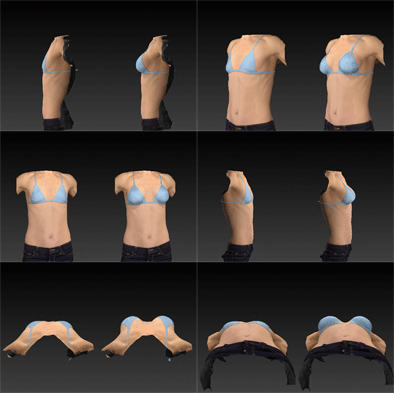
What is a Tummy Tuck?
The skin over the abdomen area can become stretched after childbirth or weight loss. This skin does not retract to its original tightness and can remain loose and saggy. The abdominal muscles are also compromised and may not regain their normal strength for repositioning, which gives a “pot belly” appearance, no matter how many sit-ups a person does. An abdominoplasty (tummy tuck) will correct both of these problems by removing excess skin and tightening the muscles to firm up the abdomen.
The patient below is 1 year post-op after a full tummy tuck:

There are different options for abdominoplasty surgery. Dr. Adams generally performs 2 types: “Full” Tummy Tucks and Modified Mini-Tummy Tucks. Depending on the amount of skin laxity, fat distribution, and muscle wall bulge, some patients qualify for the more simple modified mini-abdominoplasty (shown below).
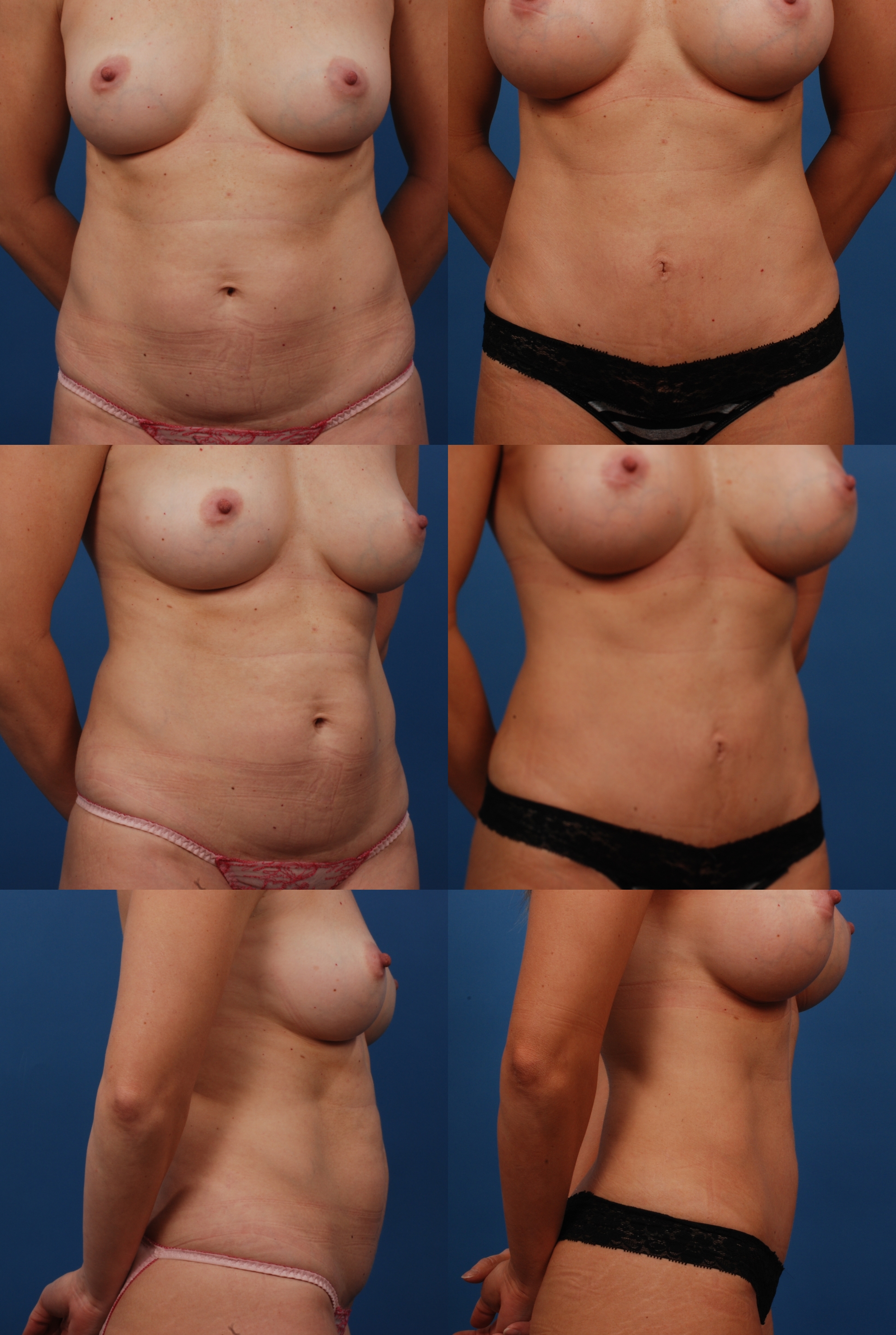
A modified mini-tummy tuck removes less skin and has a slightly shorter scar. However, comparable to a full abdominoplasty, the entire muscle wall will be tightened and flattened the same.
What does Abdominoplasty accomplish?
This plastic surgery procedure will smooth out the abdomen and the internal muscle structure and remove unnecessary excess skin.
View before and after abdominoplasty photos of tummy tuck surgery here
What happens during the first consultation?
The first consultation allows you to meet with Dr. Adams and staff to discuss your needs and concerns in a comfortable, informative setting. You will learn about your surgical options, the risks and complications, recovery time, and look through before and after pictures of consented previous patients and cases similar to yours. The meeting with Dr. Adams covers all aspects of the surgery process and gives you the opportunity to address your desires and expectations for the outcome. We will take professional photos of your abdominal/hip region, which allows for thorough planning of the surgery and recovery, and documentation of your overall progress. Additionally, Dr. Adams will perform a body examination to assess skin quality, measure amount of fatty tissue, and review your general health.
Dr. Adams individualizes your total treatment plan and will explain what type of abdominoplasty will give you the best results, i.e. mini-abdominoplasty vs. full abdominoplasty vs. extended abdominoplasty.
How is it done?
A tummy tuck is performed under general anesthesia and usually takes three to four hours. Prior to anesthesia, Dr. Adams will mark your incision lines, which will extend hip to hip or longer. During surgery, the incision is made and the skin is lifted from the abdominal wall, up to the xyphoid process. The umbilicus is released from its positioning in the dermis, but will remain attached to the abdominal wall. The muscles are then tightened and the skin is then re-draped over the abdomen. The umbilicus is marked for a new position and excess skin is removed. The skin is sutured in place with a combination of absorbable and non-absorbable sutures.
Two drains will be placed under the incision and will remain for a week to ten days. The drains remove and collect fluid that the body naturally produces as a healing mechanism after surgery.
After the incisions are closed and covered in dressing, you will be carefully transported to the post-operative care unit. For most abdominoplasty cases, it is required to spend one night in the surgery center. You are released the next morning under restrictions of limited activity.
During the procedure, Dr. Adams will inject a three-day non-narcotic pain relief medication (Exparel), which significantly reduces initial post-operative pain at home. For the next 1-2 weeks you will walk slightly stooped over and lay in a flexed & bent position to prevent you from laying flat in bed and becoming more stiff.
What can I expect after surgery?
Recovery time:
Plan on 2-3 weeks of limited activity and possible assistance from a caretaker- friend, spouse, or relative. The first ten days you are stooped over and walking cautiously. As the skin stretches and gets used to its new positioning, you will slowly begin to straighten your posture.
Drains may be removed within 10 days, depending on a consistent 24-hour low amount of outputs. While the drains are intact, you are required to record the fluid amount twice daily. Dr. Adams’ assistant will contact you every day after your surgery to monitor your amounts and check on your progress. Wound care around the drain sites and incisions is easy and you will be taught how to properly care for these areas before you leave the surgery center, with additional take-home instructions.
We provide you with medications for pain and for prevention of wound infection. The pain medication is taken as needed and the antibiotic will be taken as directed, until all medication is gone.
You are also required to wear a compression garment/binder for two weeks day and night. The following two weeks (weeks 3 & 4 post-op), you may opt to only wear at night. Some patients prefer continuing to wear the compression garment day and night (weeks 3 & 4 post-op) to further add support to the new tummy.
How many visits do I have after surgery?
You will return to have the drains removed within 7-10 days. A tummy tuck procedure requires attentive care and monitoring. We must see you for frequent in-person visits throughout the first month to ensure optimal healing, health, and progress.
Am I a good candidate for abdominoplasty?
Your visit with your surgeon will determine if you are a good candidate. If you are in good physical and mental health with reasonable expectations, you should be an appropriate candidate for tummy tuck surgery.
What does the surgery cost?
Due to the range of surgical options for a tummy tuck and factors regarding a patient’s specific needs & anatomy, there is a range in cost. At the consultation, we will provide you with your quote- including the doctor fee, anesthesia, and surgery center.
Before coming in for the consultation with Dr. Adams, we schedule a complimentary phone call with the Patient Consultant. We offer this pre-consult phone call to all of our new patients for a more personalized, informative experience. During the call, the Patient Consultant will acquire personal details from you on the front end, review your health history, and answer questions. At this time, she is able to prepare you by giving you an idea for cost and recommendations, which is confirmed at your appointment.
How do I pay for surgery?
For your convenience the fees will be paid in one sum to William P. Adams, Jr. MD PA, prior to your surgery, at least two weeks in advance. You may pay by cash, card, or check and can discuss your options for financing, if needed.
Are there scars?
Yes. All major surgeries performed on the body will result in scarring.
If you are a candidate for a mini-abdominoplasty, your scar is more minimal, to the width of your pubic region. For more severe laxity and major cases, the standard abdominoplasty incision extends at least from hip to hip. With diligent attention and scar therapy, this long scar usually heals nicely but may always be present to some extent. It will take at least a year for the scar to mature and fade from red to pink to pale. It is usually not visible in your swimsuit or underwear, due to the low placement above the pubis region. During your first consultation visit, Dr. Adams will discuss the specifics of your incision placement.
Dr. Adams continues to use the latest techniques to minimize scarring and make your existing scar look as best as possible. Starting one week after surgery, you will begin your post-operative scar therapy regimen and can discuss future options such a laser treatment, to further assist with the scar outcome.
Does it hurt?
You will have experience discomfort following your tummy tuck surgery, with manageable tender pain. Dr. Adams injects a medication called Exparel during surgery. Exparel provides pain control the first few days after surgery when it is needed the most for all tummy-tuck procedures, which significantly decreases initial post-procedure pain.
When you are discharged from the surgery center, you will be given prescriptions for additional pain and discomfort, as needed.
Where is the surgery performed?
The tummy tuck is performed at a fully accredited facility, Park Cities Surgery Center. Once examined, Dr. Adams will determine if an overnight stay at the facility is required.
What medications should I avoid?
You should avoid or stop taking all prescribed or over the counter weight/diet medications and supplements. Homeopathic medications must be approved by Dr. Adams. It is especially important to be off St. John’s Wort and Ginseng, which can cause adverse effects during anesthesia.
Please refrain from NSAIDS- Aspirin, Advil, Ibuprofen, Motrin, in the weeks leading up to surgery and after surgery, as these medications can cause bleeding problems. Please inform your surgeon what medications you are on (prescription or non-prescription) to ensure the safety for any surgery.
If you have any questions regarding your options for Abdominoplasty or would like to schedule a consultation with Dr. Adams, contact us today!